

Every year, euCNC (the European Conference on Networks and Communications) brings together Europe’s telecommunications elite to discuss the challenges of 5G, 6G and the networks of the future. Held in conjunction with the 6G Summit, it is the place where the European Union’s connectivity research projects come to life, where new developments are put to the test, and where the connectivity of tomorrow takes shape.
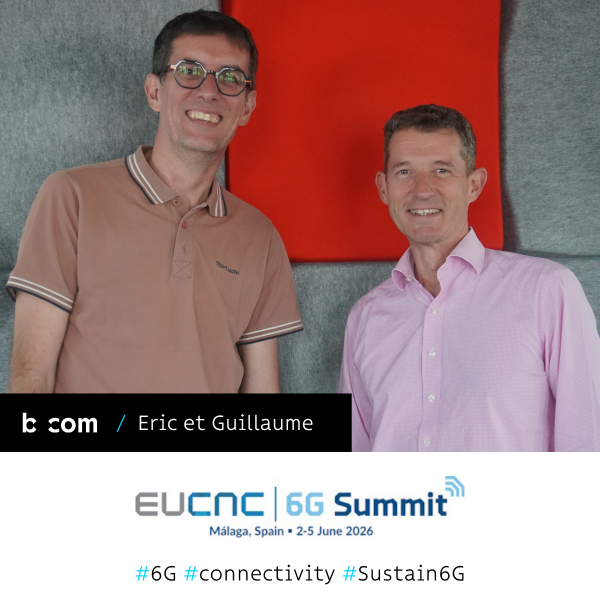
This year, b<>com will be represented by Éric Gatel, Head of Project Engineering and European Strategy, and Guillaume Vercasson, Advanced Connectivity Engineer, as part of the European SUSTAIN-6G project led by Nokia Germany and Orange France.
In this interview, they outline b<>com’s technical contributions to the project (optimisation of LDPC coding in collaboration with Orange and the FiWi wireless optical link) and shed light on b<>com’s role in European technological research.
What is SUSTAIN-6G, and why is this project important ?
Guillaume: The SUSTAIN-6G project aims to develop a comprehensive sustainability framework for 6G, incorporating three dimensions: environmental (energy, CO₂, resources), societal (impact on usage, inclusion) and economic (costs, industrial viability). The idea is to consider 6G from end to end, from the device right through to the applications. Use cases in agriculture, energy and healthcare will enable us to measure the real-world impact.
A concrete example: one partner is working on connected agriculture, using sensors to measure soil parameters to optimise irrigation. Expected results: a 15% reduction in water consumption, an 18% reduction in pesticide use, and a 15% increase in production. SUSTAIN-6G directly addresses the fact that these areas have historically been neglected by operators.
In practical terms, what does our work on SUSTAIN6G involve?
Guillaume: We have two quite different contributions. The first, in collaboration with Orange, focuses on LDPC (Low-Density Parity-Check) coding, the error-correction algorithm used in the physical layer of 5G NR networks, which is being carried over to 6G. By combining the study of the code with the performance of the associated iterative decoding algorithm, we achieve direct gains in link efficiency: the same coverage at reduced power, or extended coverage at the same power. The energy impact is immediate. We act as a neutral arbiter in the 3GPP working groups, implementing competing proposals on FPGAs to produce performance comparisons in a hardware-neutral environment, much more quickly than software simulations. The proposals are also tested ‘over the air’, using a 5G system adapted for research purposes, in order to compare theoretical improvements with real-world conditions
The second contribution is FiWi (Fibre Wireless) technology, which is similar to FSO (Free-Space Optical communication) but designed for indoor use. The principle is to eliminate the conversion to a radio signal in the final transmission segment and replace it with a collimated optical beam travelling through the air. The signal remains in the optical domain from end to end. The result: no interference, no radio-frequency emissions, natural confidentiality due to the signal’s directionality, agnostic to the standard used, and energy efficiency far superior to that of a conventional radio link. The challenge lies in pointing: we are working with beams just a few millimetres in diameter, which requires precise dynamic alignment. Our system combines a collimator at the fibre output, steerable micro-mirrors and a camera that detects the terminal’s position in real time via an active LED pattern. The link is symmetrical in both directions.
What will you be presenting at EuCNC?
Guillaume: The FiWi demo: an access point mounted at height, a target on the table simulating user equipment, and a green laser that dynamically tracks its movements. It’s very visually striking.
We will also be showcasing ZeDIoT (Zero Energy Device IoT) modules – small, autonomous sensors powered by solar panels that measure temperature, humidity and light levels. They adjust their transmission frequency to maintain the battery charge level at around 50% and extend its lifespan. Deployed in real-world conditions in our lab, they will be connected to a monitoring application developed by our partner Wings, featuring a digital twin of the system in its environment and a data history. This will provide a concrete vision of what a 6G network designed for real-world use could look like.
Why is the European dimension so important in our work?
Éric: European projects enable us to compare the expertise of our researchers with that of our partners, and to advance the maturity of our technologies, which then form the foundation for future innovation projects. By contributing our technological building blocks to these consortia, we help to develop more comprehensive solutions that serve Europe’s sovereignty and ambitions. It is this positioning that makes b<>com a leading European player in sovereign, sustainable and industrialisable digital technologies.
What are your ambitions for European 6G and other technologies ?
Éric: Beyond the major technical advances it will bring, 6G is becoming a real issue of sovereignty as it will underpin critical infrastructure, such as industry, healthcare and defence. Europe must be able to control these key technological building blocks. Through its research and contributions to European projects, b<>com seeks to build a European 6G that is sovereign, innovative and responsible.
Our expertise is not limited to connectivity: our ambition spans a range of strategic technologies such as AI, XR/VR, digital twins, cloud computing, human factors, embedded systems, foresight and design, with an end-to-end approach, from infrastructure to industrial applications.