


A machine that shuts down without warning results in an immediate financial loss. In many facilities, the challenge is no longer simply to repair the machine, but to prevent such incidents from happening in the first place. Today, the performance of an industrial site depends on its ability to turn data into tools for forecasting.
Yet the data is already there. Sensors are collecting data, servers are filling up, but these data streams remain untapped. The bottleneck is no longer technical; it is analytical: we do not yet know how to interpret this digital ‘noise’ in order to make the right decisions.
The work carried out at b<>com, in collaboration with an industrial ecosystem, aims to move beyond reactive maintenance through the application of AI. By transforming raw data into performance indicators, this research makes it possible to anticipate maintenance needs and ensure greater stability in production equipment.
From reactive maintenance to predictive maintenance: a major leap forward
Reactive maintenance takes place after a breakdown. It is reactive, expensive and has a direct impact on service quality.
Systematic preventive maintenance is based on fixed replacement intervals, calculated using the average service life of a component. This statistical approach does not reflect the actual condition of the equipment. Without predictive capabilities, industrial data remains untapped from an operational perspective.
It is precisely this prediction-related obstacle that the teams at b<>com, experts in applied AI and time series analysis, are overcoming.
By leveraging machine learning and enriched knowledge bases, real-time data processing is taken to a whole new level. This approach finally makes it possible to:
- Predict breakdowns before machinery comes to a standstill;
- Move away from rigid schedules to optimise maintenance;
- Reduce operating costs whilst ensuring service quality.

The data is there, but it’s only valuable if we know how to interpret it at the right moment. That’s what this project is all about: equipping manufacturers with AI-powered predictive and corrective capabilities, with a view to moving towards controlled and proactive maintenance.
Predicting, supporting and sharing industrial maintenance through AI
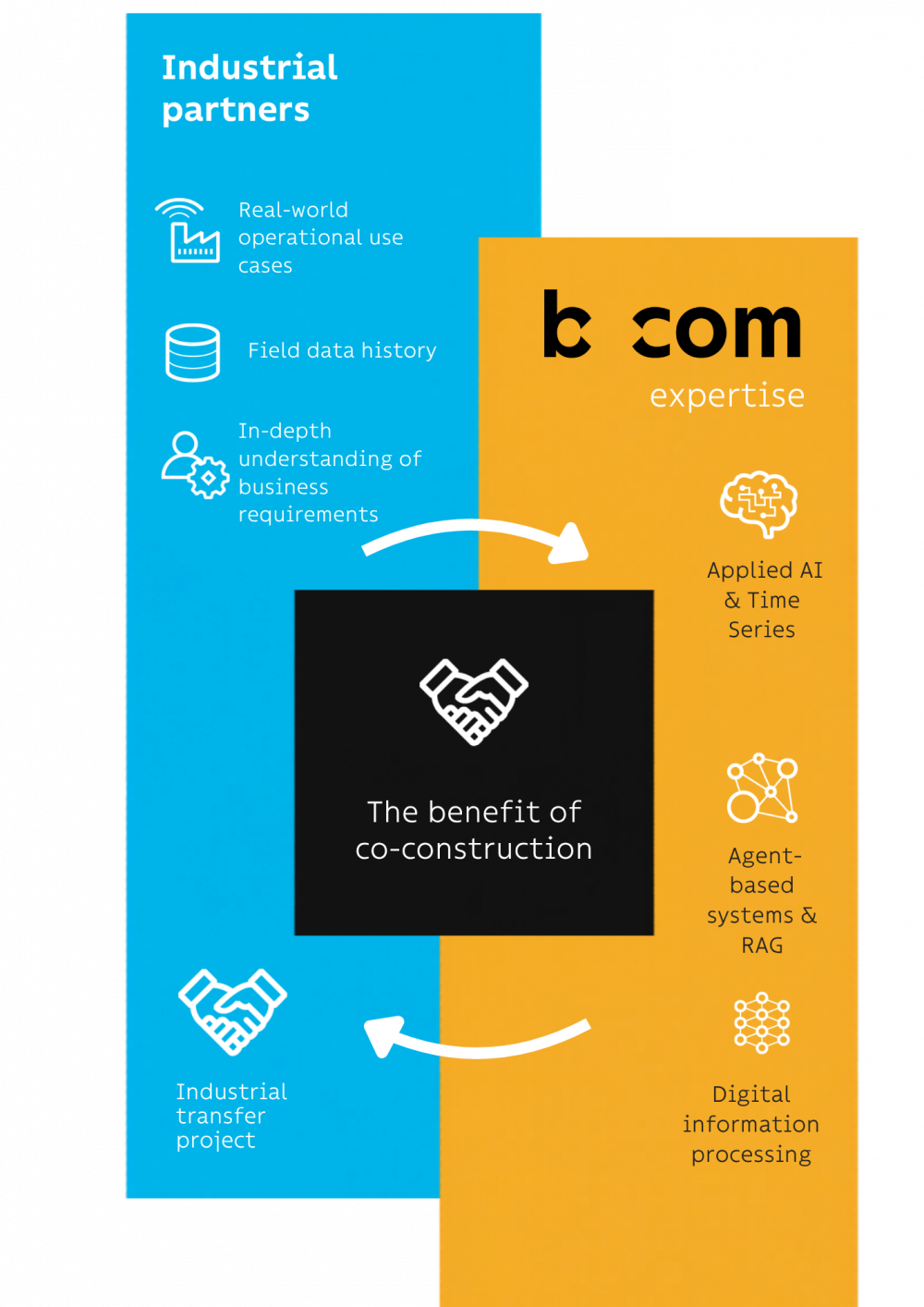
Several practical use cases are currently being studied as part of the research programme led by b<>com.
In the field of connected livestock farming, the teams at b<>com are developing a system for analysing cattle behaviour: moving from observation to prediction and anomaly detection. This is a practical example of multivariate and multimodal time-series analysis applied to real-world data.
To make vast amounts of technical documentation (PDFs, diagrams, specifications) usable and thereby speed up fault resolution, the teams at b<>com are providing a key technological solution to a defence contractor. The work is based on a RAG (Retrieval-Augmented Generation) system: at the technician’s request, an agent queries a vector database of technical documents and returns a contextual response geared towards troubleshooting.
Finally, a technology partner specialising in time series analysis is turning to b<>com to take a decisive step forward: extending its work to multivariate and multimodal data based on real-world data — a challenge with significant industrial potential that can only be addressed by pooling expertise.
What benefits can be expected from the use of AI in maintenance?
Putting an end to the extra costs of unexpected breakdowns
The financial benefit is clear: you no longer have to put up with the problem. Detecting weak signals within time series makes it possible to anticipate anomalies well before they bring the production line to a standstill. This eliminates the need for emergency interventions, which are expensive and disrupt schedules.
Securing human intervention in the field
AI does not replace humans; it empowers them to manage complexity. A diagnosis can take hours due to the volume of technical documentation. AI assistants query these complex knowledge bases to extract the answer instantly. Technicians are therefore no longer left to struggle with the manual on their own: they receive a context-sensitive solution that gives them confidence in their actions and speeds up the resolution of the fault.
Maximising the value of industrial assets over the long term
We are finally moving away from ‘blind’ preventive maintenance, which involves replacing parts that are still in good working order purely as a statistical precaution. The aim here is to rely on multivariate and multimodal data to accurately reflect the machine’s actual condition. We avoid wasting functional components, protect equipment over the long term and maximise the return on the initial investment. Management is therefore precise, dictated by the realities on the ground and not by a theoretical average.
Are you interested in industrial maintenance issues? The teams at b<>com are available to discuss them with you.