

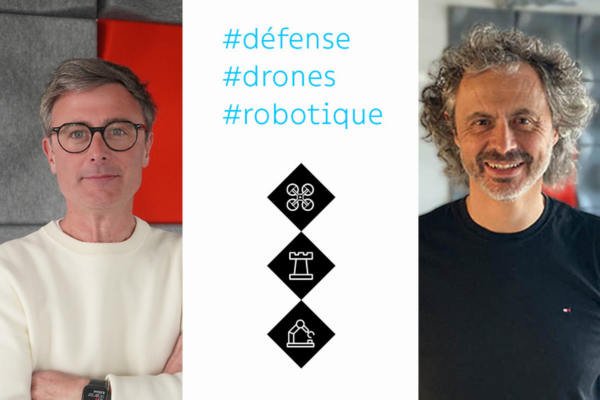
Eurosatory 2026 confirmed what feedback from the Ukrainian front line had already indicated: autonomous systems, tactical connectivity and embedded intelligence have become strategic priorities for defence manufacturers. b<>com is responding to this. Interview.
Navigating without GNSS, detecting drone intrusions and making decisions despite degraded communications. These three capabilities have become critical for the armed forces, and are three areas in which b<>com is already working, notably as part of the launch of the drones and robotics project. Attending Eurosatory 2026, Nicolas Ramin, Deputy Director of Expertise & Innovation, and Patrick Savelli, Head of Networks and Connectivity Strategy, observed a sector undergoing rapid transformation, shaped by lessons learnt from the conflict in Ukraine, the rise of autonomous systems and the growing demand for resilience. Interview.
Does Eurosatory 2026 confirm a shift in the technological requirements of the armed forces?
Nicolas Ramin: We met a huge number of stakeholders, our industrial partners and new contacts. What stands out about this year’s event, beyond the ubiquity of drones, is their operational transformation. Gone are the days when they were merely observation tools: the exhibition marks the advent of grenade-launching drones and single-use delivery systems converted into fully-fledged autonomous or remotely-operated munitions. This evolution in capabilities is a direct legacy of the Ukrainian front.
At b<>com, we are more interested in tactical observation and intelligence drones capable of carrying advanced processing systems. The need that is emerging very clearly today is for GNSS-independent navigation. On the ground, jamming has become a constant reality. Even more problematic is spoofing: a drone may receive a false GPS signal, believe it is in the correct location, and continue its mission without realising it has been deceived.
To address these challenges, we are drawing on computer vision technologies that we have been developing for ten years and which offer a wide range of dual-use applications. We are creating a VPS (Visual Positioning System): we extract visual landmarks from satellite images, load them onto the drone, and the drone then compares what it observes with this reference frame to determine its location. In a sense, it navigates by sight, just as a human navigator would.
Patrick Savelli: Eurosatory also demonstrates that land forces are becoming fully-fledged, connected, resilient and data-driven combat systems. The challenge is simple: to be able to make decisions faster than the adversary.
We have seen extremely advanced platforms that aggregate information from multiple sensors, provide recommendations using artificial intelligence, and enable operational orders to be disseminated very quickly. We do not develop these integrated systems ourselves, but we can provide them with essential building blocks: embedded AI, data fusion, real-time analysis engines and tactical digital twins.
Essentially, four key requirements dominate today: accelerating decision-making, maintaining digital capabilities in degraded environments, making autonomous systems more robust, and embedding more intelligence as close as possible to the sensors.
In the field of video analysis and computer vision, the armed forces are now generating vast volumes of data streams: drones, surveillance cameras, EO/IR imagery. What is the real technical challenge, and how is b<>com tackling it?
Nicolas Ramin: The main challenge is no longer capturing or transmitting data. It is understanding it in real time, directly on board the systems, whilst operating within strict energy and computing power constraints.
Take the example of navigation without GPS. The challenge is to identify recognisable visual landmarks in images produced by a drone, using reference points previously extracted from satellite images. In practical terms, a building or the course of a road does not look at all the same when viewed vertically from space as it does from the oblique angle of a drone flying at low altitude. Added to this difference in perspective is the fact that these reference images may have been captured at a different time of day, in different weather conditions, or even in a very different season. The real challenge, therefore, lies in identifying landmarks that are robust enough to remain recognisable despite these variations. This is a complex area of computer vision, on which our teams have been working for several years.
The second challenge is to produce “augmented intelligence”. For example, we are developing capabilities for 3D reconstruction, as well as the detection, recognition and identification of targets.
A drone flying over a facility captures video footage, from which we reconstruct a photorealistic 3D representation of its surroundings. The resulting 3D model is of obvious value for intelligence missions.
We are also working on the detection, recognition and identification of targets. Detecting a vehicle is one thing; being able to identify it from just a visible part, in an obscured or dimly lit environment, is quite another. The challenge lies in scaling up the production of data and artificial intelligence models that can then be embedded in low-power processors, directly on the device itself, without relying on a remote data centre.
What have you observed regarding the challenges of tactical connectivity?
Patrick Savelli: One trend is very clear: we are moving from networks that are simply high-performance to networks that are resilient, adaptive and multi-path, capable of withstanding interference, cyber-attacks and link failures.
Tactical mesh networks are playing an increasingly important role. Every soldier, vehicle or drone can act as a relay. If one element goes down, the network automatically reconfigures itself.
At b<>com, we are developing several technologies that meet these needs. We are working on resilient long-range 5G communications, notably via a feature we are developing for a long-established defence contractor, on the integration of terrestrial and non-terrestrial networks, on real-time radio spectrum analysis using RF fingerprinting, on the ability to detect drones based on their radio signatures, as well as on 6G/ISAC passive radar approaches that enable the use of existing communications infrastructure to detect flying objects.
Understanding the electromagnetic environment surrounding an autonomous system is becoming an essential capability. It is now a matter of operational survival.
In what way is the IRT model particularly relevant to the defence industry ?
Nicolas Ramin: Because it enables us to achieve what no single player can accomplish on their own: ecosystem innovation. And within a secure environment: our role as a trusted third party is essential in these areas. We can bring together drone operators, suppliers of inertial sensors, optronics specialists, tactical communications providers and satellite data suppliers around a single roadmap. Our role is that of a neutral trusted third party that facilitates the co-creation of value.
We are currently forming a consortium focused on aerial and robotic systems in challenging environments. We are seeking partners capable of contributing their technological expertise so that, together, we can build the building blocks that sovereign autonomous systems will require.
Patrick Savelli: We are already working on these issues with several of our members involved in defence activities, such as Orange, TDF, Airbus Defence & Space and Kineis. With this in mind, we also wish to involve other players in the sector in order to broaden the discussion and foster collaboration on these topics.
It should be noted that the building blocks we are developing are intended to be dual-use. Issues such as navigation without GNSS, perception in degraded conditions and resilient communications are also relevant to precision agriculture, infrastructure inspection and civil surveillance.
This is also the strength of an IRT: developing technologies that meet strategic needs whilst finding applications across several economic sectors.
Digital sovereignty is a frequent topic of discussion. What does it actually mean?
Patrick Savelli: For me, digital sovereignty is not a political concept. It is an engineering constraint.
When you deploy a tactical network without having a firm grasp of the protocols, the equipment or the data paths, you are accepting a dependency. Yet such a dependency can become a vulnerability during operations.
Our Open XG Hub platform is based on this principle. It aims to provide an open experimental environment enabling European stakeholders to test, develop and influence the standards of tomorrow, rather than simply having to accept them.
This also involves designing architectures capable of operating in degraded mode. A network that loses a link must not collapse. It must continue to perform its essential functions.
Would you like to contribute to b<>com’s Drones & Robotics project? Manufacturers, operators, sensor suppliers, and companies specialising in optronics or tactical communications are invited to join this dynamic co-innovation initiative.